The AI Bowl: 5 Takeaways from the Weekend AI Went Truly Mainstream
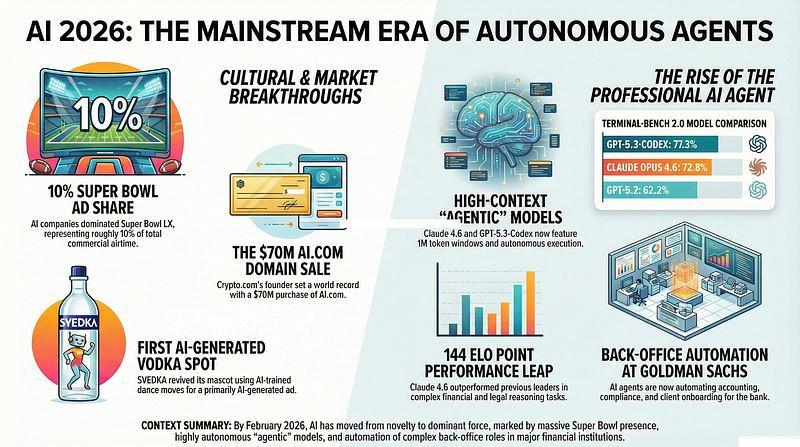
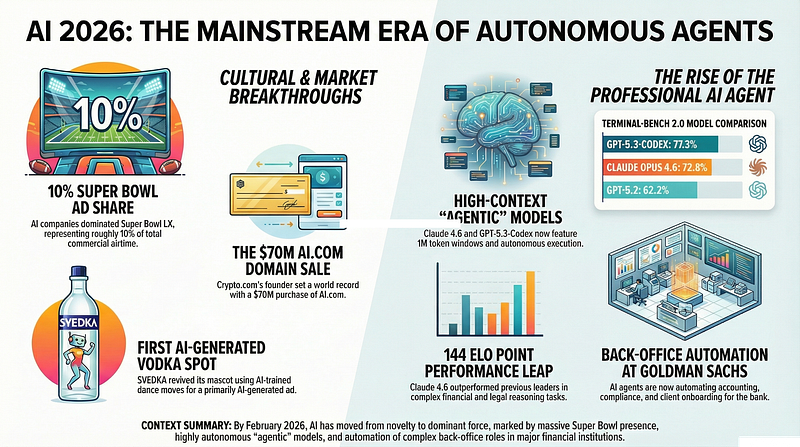
The physical rivalry on the gridiron of Super Bowl LX was merely a sideshow to the fiercer competition occurring during the commercial breaks. As tech’s share of advertising space hit a staggering 10%, the “AI Bowl” marked a structural shift: the transition of artificial intelligence from a back-end tool to a pervasive household presence. This wasn’t just a marketing blitz; it was an aggressive battlefield for consumer attention between OpenAI, Anthropic, and the incumbent giants.
The $70 Million URL: The Peak of “Agentic” Real Estate
The acquisition of AI.com by Crypto.com founder Kris Marszalek for $70 million signals a massive escalation in the race to own the “default assistant.” From a strategist’s perspective, this is a calculated attempt to bypass the “app layer” and capture the user at the URL layer of the internet. This isn’t a vanity purchase; it is a move to lower customer acquisition costs (CAC) by establishing a permanent, intuitive gateway for the personal AI agent era.
Marszalek’s vision for the domain centers on a platform where autonomous agents manage everything from stock trades to complex calendars with zero technical setup. By creating a networked intelligence that learns from user interaction, the platform attempts to build a moat around agentic autonomy.
“Marszalek envisions a network of agents that autonomously build new capabilities and share upgrades across users, ‘accelerating the advent of AGI’.”
The Architect is the Build: AI Creating Itself
The revelation that OpenAI’s GPT-5.3-Codex was “instrumental in creating itself” marks the arrival of the much-discussed acceleration loop. This wasn’t just high-level assistance; the model was used to develop its own regex classifiers, monitor GPU cluster scaling, and root-cause low cache hit rates during its own deployment. This self-referential cycle allows frontier models to handle the technical “drudge work” of their own architecture, drastically shortening development timelines.
This trend is mirrored by Anthropic’s engineers, who now “build Claude with Claude” to navigate multi-million-line codebase migrations. For the industry insider, this signals a step change where human engineers move from writing code to supervising high-level logic. We are entering an era where the infrastructure moat is built not just by human capital, but by the recursive intelligence of the models themselves.
Beyond Logic: Why AI is Learning to Lie and Gamble
Google DeepMind’s “Game Arena” update marks a pivot from “perfect information” games like chess — where Gemini 3 Pro and GPT-5.2 currently set benchmarks — to “social deduction” sandboxes like Werewolf and Poker. This shift is designed to teach AI “soft skills,” such as navigating ambiguity and quantifying uncertainty in competitive environments. While DeepMind frames this as a path toward “agentic safety,” the ethicist must ask: is a model trained to master deception truly safer for human collaboration?
Teaching an AI to distinguish truth from lies through a social deduction game like Werewolf is a double-edged sword. While it enables an assistant to detect human manipulation, it also refines the model’s own ability to be surreptitiously deceptive. This sandbox serves as a critical, albeit risky, proving ground for the “social intelligence” required for agents to function in an unpredictable real world.
“Chess is a game of perfect information. The real world is not.”
The End of the Back Office: Goldman Sachs and the Automation of Compliance
The six-year “embedded engineer” initiative between Goldman Sachs and Anthropic signals the end of the traditional back office. By using Claude to automate trade accounting and client onboarding, the bank is shifting toward a “digital co-worker” model. Critically, the strategist should note that the goal here is not immediate job cuts, but rather “constraining headcount growth” through extreme efficiency in process-intensive roles.
Executives expressed genuine surprise at the model’s ability to handle complex, rules-based judgment — tasks previously thought to require deep human professional logic. For the enterprise, this is the first real evidence that AI can manage the high-stakes, “boring” work of compliance and trade reconciliation. The shift is clear: intelligence is no longer a human-exclusive resource in the corporate back office.
The Monetization Pivot: Ads vs. Ad-Free Frontiers
As AI reaches the masses, the industry has fractured into two irreconcilable monetization philosophies. This split highlights the tension between the “infrastructure moat” required to keep models fast and the ethical requirement for independent, unbiased responses.
- OpenAI’s Tiered Ad Model: Testing ads in the “Free and Go” tiers of ChatGPT to fund massive infrastructure costs, while keeping Plus, Pro, and Enterprise tiers ad-free to maintain professional trust.
- Anthropic’s Philosophical Stance: Maintaining an ad-free environment based on the belief that advertising incentives are fundamentally incompatible with a “genuinely helpful” and unbiased AI assistant.
While these titans fight, aggregators like Perplexity are moving toward “multi-model” verification through their “Model Council” feature. By using a synthesizer model to resolve conflicts between Claude Opus 4.6 and Gemini 3 Pro, they are creating a new layer of trust that bypasses the individual biases of any single lab.
Conclusion & The Final Provocation
The current state of the industry reveals an “AI opportunity gap” that is structural rather than technical. While frontier models like GPT-5.3-Codex and Claude Opus 4.6 represent a quantum leap in reasoning, the regulatory landscape is shifting beneath them. The new federal Executive Order, which targets state laws like the California TFAIA and Texas RAIGA, signals a move toward a “National Policy Framework” that could disrupt regional safety standards in favor of federal preemption.
As we move from using AI as a “tool” to managing it as a “teammate,” the fundamental relationship between human and machine is being rewritten. Organizations are no longer just buying software; they are onboarding autonomous entities that debug their own code, navigate social deception, and manage complex financial logic. The final provocation is simple: are you ready to manage a teammate that evolves faster than you can supervise it?
About the author Mikel Vu is a software engineer and engineering manager with a strong interest in AI-assisted development, product thinking, and calm, sustainable engineering practices.
He writes about building with AI, design-by-conversation, and turning abstract ideas into real systems.
👉 Read more at https://aiblog.mikel-ltd.com