5 Surprising Ways Claude Cowork is Rewriting the Rules of Work
Modern knowledge work is navigating a paradigm collapse. For years, we have normalized a quiet, persistent chaos: “Downloads” folders that serve as graveyards for unsorted PDFs, the manual slog of matching receipts to spreadsheets, and the friction of constant copy-pasting between separate apps and AI interfaces.
In January 2026, the era of the chatbot officially ended. The launch of Claude Cowork marks an evolutionary leap from AI as a conversational novelty to AI as a functional engine. This is the shift from “chatting” to “doing” — a transition into agentic execution where the AI doesn’t just suggest work; it completes it.
Image from https://claude.com/product/cowork
From Chat-Bot to Background Colleague
The fundamental shift in Claude Cowork is the move from a standard chat model to autonomous execution. In the old model, you provided constant context and managed every sub-step. In the “Cowork” model, you point Claude to a folder, define an outcome, and step away.
Inside the UI, this transition is signaled by the new “Tasks” selector in the sidebar. This isn’t a conversation; it’s a queue. The “agentic” difference is defined by:
- Outcome-Oriented Tasks: Claude focuses on a final goal — like “reconcile these expenses” — rather than individual prompts.
- Persistent Context: It maintains the state of a task over time, breaking work into sub-tasks and progressing without losing its way.
- Autonomous Operation: Once a task is queued, Claude works independently, reducing the constant back-and-forth interaction that defined 2024-era AI.
“Claude will make a plan and steadily complete it, while looping you in on what it’s up to… [representing a shift to] agentic execution that feels more like a helpful colleague working in the background.”
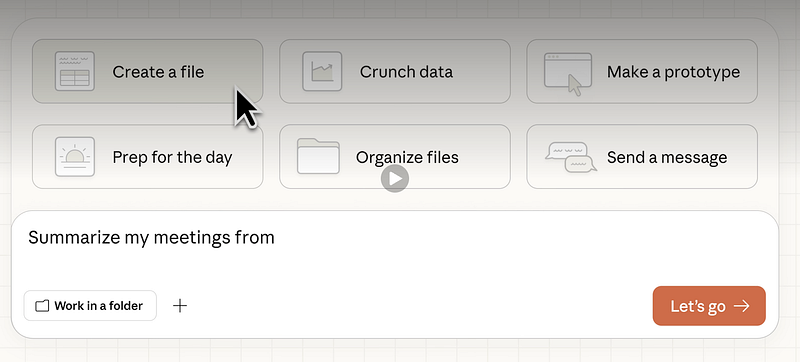
Image from https://www.anthropic.com/product/claude-cowork
“Vibe Coding” and the Democratic Agent
Claude Cowork is “Claude Code for the rest of us.” It is built on the same high-powered Agent SDK as Anthropic’s developer tool, but it removes the terminal-heavy barrier entirely. In a remarkable feat of “vibe coding,” Anthropic engineers reportedly built the initial version of Cowork in just 10 days using Claude Code itself to automate its own development.
This matters because it democratizes high-level agency. You no longer need to touch a command line or write complex scripts to automate your digital workspace. By packaging autonomous reasoning into a point-and-click desktop experience, Anthropic has turned complex “developer-only” automation into a standard tool for every knowledge worker.
The P.A.L.T. Factor: Solving Problems Before They Have Names
Breakthrough AI doesn’t come from surveys; it comes from watching users “hack” their way out of drudgery. Anthropic developed Cowork by identifying P.A.L.T. (Painful + Latent) problems — tasks so tedious that we’ve stopped complaining about them because we assume they are inevitable.
Engineers noticed users bending developer tools to perform bizarrely domestic tasks: tracking plant growth, controlling smart ovens, or researching vacations. These users were willing to fight a scary command-line interface just to escape manual “life admin.”
Latent Problems are Pre-Language. Because we have lived with messy directories and manual data entry for decades, we didn’t have the language to ask for an autonomous agent until we saw one. Claude Cowork makes these invisible burdens visible, then deletes them.
Specialist Plugins: Turning Markdown into Functional Expertise
Claude Cowork uses a plugin system that allows it to adopt specific professional roles. These aren’t just clever prompts; they are bundles of specialized skills and connectors powered by the Model Context Protocol (MCP).
Crucially, these plugins are just collections of Markdown and JSON files. This makes the system transparent and “hackable” — if you can edit a text file, you can peek under the hood and tweak a workflow to fit your specific company culture.
Current real-world applications include:
- Sales: Connecting to CRM tools like HubSpot to research prospects and draft personalized outreach.
- Finance: Using Snowflake or BigQuery connectors to reconcile accounts and generate statements from raw data.
- Operations: Taking a chaotic local directory of receipts and transforming them into structured project folders and formatted reports.
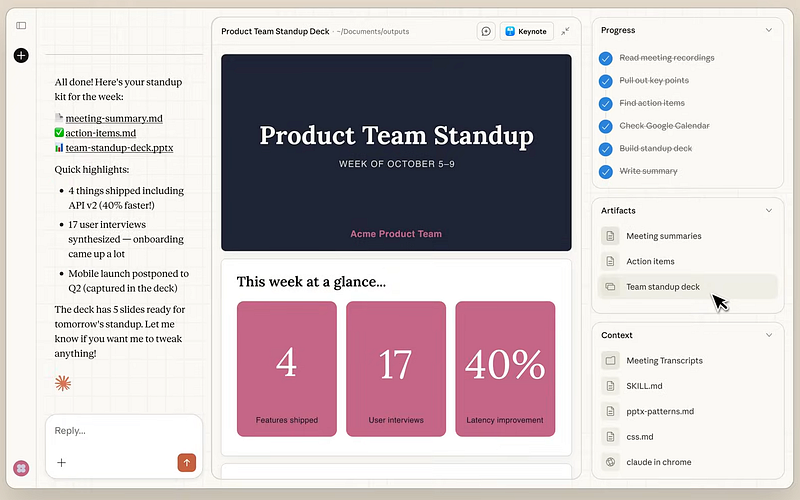
Image from https://www.anthropic.com/product/claude-cowork
High Power, Isolated Control
When you give an AI the power to act on your file system, you introduce the risk of destructive actions. Anthropic’s safety model is an architectural choice, not just a set of rules. Execution happens within an isolated Virtual Machine (Apple’s VZVirtualMachine). This creates a hard boundary: the AI cannot “escape” the sandboxed folder you designate.
However, this high level of local control comes with trade-offs. As of early 2026, Cowork is strictly a desktop experience. There is no web or mobile support, and no cross-device sync. This is a deliberate security posture to keep your data local and your agent’s actions auditable.
“Claude can take potentially destructive actions (such as deleting local files).”
The “Ask Before Acting” protocol ensures that for any significant change, the agent surfaces its plan and waits for your explicit “Go.”
From Interaction to Collaboration
We are entering the “agent-first” era of software. Claude Cowork represents the first pragmatic step toward a world where AI understands the context of our files as deeply as we do.
The transition from manual digital labor to autonomous delegation is no longer a futuristic concept — it is a desktop reality.
Are you ready to stop talking to your AI and start working alongside it?
Hey, I’m Mikel, and you can *read more of my stories here*.