June 2026 and 4 Surprising Ways AI Just Became Your Newest Teammate
The Death of the Prompt and the Birth of the Agent
For the past few years, the enterprise world has viewed Artificial Intelligence primarily through the lens of a sophisticated search engine — a tool you “prompt” with a single question to receive a single, static answer. This interaction model is now obsolete. What we are witnessing is a fundamental re-architecting of the enterprise’s cognitive layer. We are moving from “AI as a tool” to “AI as an active participant.”
Recent breakthroughs from Google and Anthropic signal the birth of the true “agent.” This is no longer about isolated, one-off conversations; it is about “agentic” workflows featuring server-side memory, long-horizon autonomy, and a capacity for “ambient behavior.” These agents don’t just wait for instructions — they follow along, build context, and provide the tacit knowledge necessary to drive complex projects to completion. Here are the four strategic imperatives that define this new reality.
Takeaway 1: Your New Teammate is “Multiplayer” and Proactive
The era of the private chatbot window is over. Anthropic’s Claude Tag — currently in beta for Claude Enterprise and Team customers — introduces a “multiplayer” paradigm where the agent lives within shared workspaces like Slack. Rather than starting from zero with every prompt, the agent observes channel history and tool integrations to build a collective context.
The most striking evidence of this shift is found within Anthropic itself: 65% of their product team’s code is now created by their internal version of Claude Tag. This represents a seismic shift from individual productivity to team-wide delegation.
“@Claude works asynchronously. Set Claude a task, and you can focus on your other priorities while it works. It can also schedule tasks for itself, pursuing a project autonomously over hours or days.”
This “ambient” behavior reduces the massive cognitive load of onboarding a new teammate. By following along in the background, the agent acquires the tacit knowledge of a project, enabling it to proactively flag missing info or follow up on stale threads. This isn’t just efficiency; it’s the automation of project management itself.
Takeaway 2: AI Finally Has “Hands” (Native Computer Use)
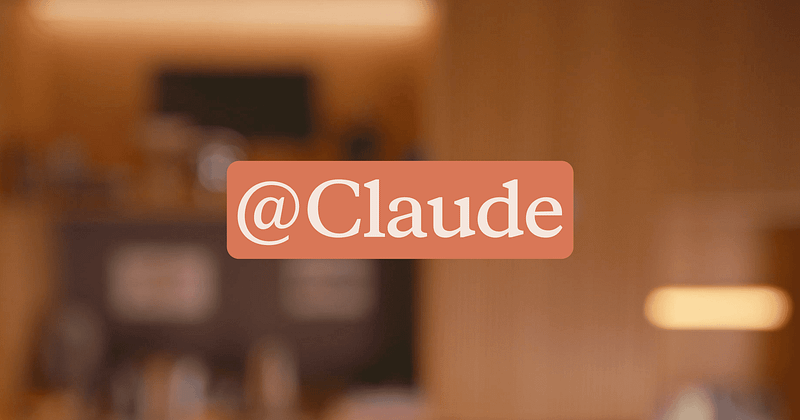
A significant bottleneck in digital transformation has been the reliance on fragile, custom APIs to connect AI to software. Google’s Gemini 3.5 Flash has shattered this barrier by integrating a native computer use tool. Agents can now “see, reason, and take action” across browser, mobile, and desktop environments just as a human would.
This allows agents to navigate a world designed for humans, performing tasks such as:
- Continuous Software Testing: Navigating new builds to identify bugs in real-time.
- Accessibility Auditing: Reviewing professional applications to identify compliance gaps.
To manage this autonomy, Google has implemented a “defense-in-depth” approach featuring two enterprise safeguard systems:
- User Confirmation: Requires explicit human authorization for sensitive or irreversible actions.
- Automatic Stop: Instantly terminates tasks if an indirect prompt injection or security risk is detected.
This is a major milestone. By removing the need for custom bridges for every task, we are moving away from rigid automation toward flexible, agentic reasoning. The AI is no longer trapped in a text box; it has been given the “hands” to manipulate the entire professional tech stack.
Takeaway 3: From “Snapshots” to “Long-Term Management” in Healthcare
AI is evolving from a diagnostic assistant providing snapshots into a partner for “longitudinal disease management.”
Google’s AMIE (Articulate Medical Intelligence Explorer) research, recently highlighted in Nature, showcases a system comprised of two specialized agents: an “empathetic dialogue agent” for real-time patient interaction and a “deep-thinking management reasoning agent” for clinical analysis.
In a blinded study, AMIE cross-referenced hundreds of pages of clinical guidelines to track symptoms over time, outperforming 21 primary care doctors in both “plan preciseness” and “guideline alignment.”
“AI could someday support medical care, giving physicians more time to spend with patients.”
The significance here is the human-centric goal. By delegating the dense, administrative burden of management reasoning — tracking formularies and parsing updated guidelines — to deep-thinking agents, we buy back the most valuable resource in medicine: the physician’s time for empathetic, face-to-face care.

Takeaway 4: The Plumbing of the Internet is being Rebuilt “Agent-First”
The most foundational shift is happening in the infrastructure. Google’s Interactions API has officially reached general availability, replacing the legacy generateContent API as the primary interface for Gemini. This technical shift moves software "From Roles to Steps." In the old model, AI followed a rigid "user/assistant" role structure. Now, every action—a thought, a function call, a piece of output—is a distinct, "typed step."
This allows for granular error handling and “stateful” memory, which are essential for long-running agents. Furthermore, the “Flex” tier offers a 50% cost reduction for developers who optimize for latency, ensuring this agentic ecosystem is economically sustainable at scale.
The **gemini-interactions-api Skill** is a specialized tool that helps other coding agents, like Antigravity, stay updated on the latest API patterns and best practices. This essentially creates an ecosystem where agents teach other agents how to use the latest capabilities.
Strategists must realize that frontier capabilities will now land exclusively here. The Interactions API is designed from the ground up for stateful, agentic workflows, signaling that the very foundation of modern software is being rebuilt to be “agent-first.”
Conclusion: The Age of Delegation
The cumulative message of these breakthroughs is undeniable: we are entering the Age of Delegation. AI has transitioned from a tool we use to an entity we manage. Whether it is a “multiplayer” agent managing a codebase, an agent with “hands” auditing your documentation, or a medical explorer tracking a long-term treatment plan, the “long-horizon” work is being automated.
For the modern leader, this is the ultimate strategic challenge:
As these agents take over the logistical and administrative heavy lifting, how will you choose to spend the time you “buy back”? The execution is now handled; the vision remains yours.
Hey, I’m Mikel, and you can *read more of my stories here*.